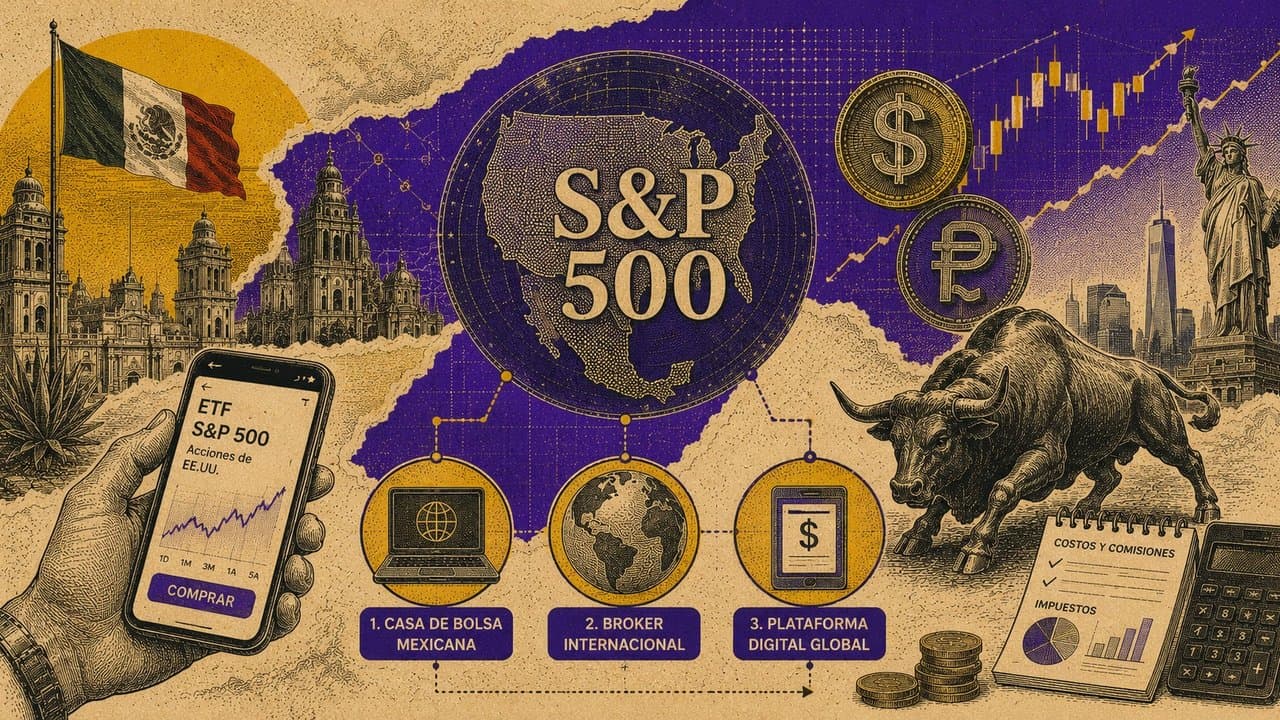
If you live in Mexico and want exposure to the biggest companies in the United States, the S&P 500 is the usual starting point. You cannot buy the index itself. You buy a fund that tracks it, and you can do that in Mexican pesos through a local broker or in US dollars through an international one. This guide walks through the three practical routes, what each one costs, and how dividends and gains are taxed for a Mexican investor.
The index, and why you invest through a fund
The S&P 500 is an index that measures the performance of roughly 500 of the largest publicly traded companies in the United States, weighted by market value. It is a benchmark, not a product, so there is no share of "the S&P 500" to purchase directly. Instead, investors use an ETF - an exchange-traded fund that holds the same basket of stocks and trades like a single share. When you buy one share of an S&P 500 ETF, you own a slice of all 500 companies at once, which is a simple way to get broad diversification.
Historically, broad US equity indices have delivered solid long-term returns, but they also fall in down years. No investment is risk-free, and past performance does not guarantee future results. An S&P 500 ETF concentrates your money in one country and one currency, so it is one building block of a portfolio, not the whole thing.
Three ways to invest from Mexico
There is more than one path, and the right one depends on whether you prefer to invest in pesos or dollars, and how hands-on you want to be.
1. S&P 500 ETFs listed on the BMV through the SIC
The Bolsa Mexicana de Valores (BMV) operates the Sistema Internacional de Cotizaciones (SIC), a segment that lists foreign securities so they can be traded locally. Through the SIC you can buy US-listed S&P 500 ETFs in pesos using a Mexican broker, during Mexican market hours, without opening a foreign account. This is the most common route for first-time investors in Mexico because everything - funding, buying, statements, tax reporting - stays inside the Mexican system.
Several regulated Mexican brokers and investment apps give access to S&P 500 ETFs through the SIC, including GBM (GBM+), Kuspit or Bursanet (Actinver). Each has its own account minimums, fee schedule and app experience. Commissions and conditions change often, so check the current fee schedule on each provider's site before you open an account rather than relying on a number you read elsewhere.
3. International brokers
You can also open an account with an international broker such as Interactive Brokers and buy the same ETFs directly on US exchanges in dollars. This can mean access to more instruments, but it also means converting pesos to dollars, understanding US paperwork, and doing your own Mexican tax reporting on foreign holdings. It tends to suit investors who are already comfortable with the basics.
The most common S&P 500 ETFs
Three ETFs track the S&P 500 and are widely available to Mexican investors through the SIC. They hold essentially the same stocks; the main day-to-day difference for a long-term investor is the expense ratio - the annual fee the fund charges, expressed as a percentage of your investment. A 0.03% expense ratio means about 3 pesos a year per 10,000 pesos invested, deducted automatically from the fund.
VOO (Vanguard) and IVV (iShares) both carry an expense ratio of about 0.03% per year, while SPY (SPDR) is around 0.0945%. Over a long horizon these differences are small in absolute terms, but on the same underlying index a lower ongoing fee is one thing you can control. For a fuller comparison of how these funds differ, see our dedicated ETF comparison.
Three cost layers matter, and they are separate from one another. First, the broker commission - what your Mexican broker charges per trade or as an account fee; some apps advertise zero commission on certain ETFs, others charge a percentage, so confirm it directly. Second, the fund's expense ratio, the roughly 0.03% to 0.09% annual cost above. Third, the peso-dollar exchange rate: even when you buy in pesos through the SIC, the ETF's value is tied to dollars, so the MXNUSD rate affects your returns in pesos in both directions.
Currency works both ways. If the peso weakens against the dollar, a dollar-denominated ETF is worth more in pesos, all else equal; if the peso strengthens, the opposite happens. This currency exposure is part of the risk, not a bonus.
Taxes for a Mexican investor
Two tax topics come up. The first is US dividend withholding. Dividends paid by US companies to a foreign investor are subject to a 30% US withholding tax by default. Under the Mexico-United States tax treaty, that rate can be reduced - commonly to 10% - if you sign the W-8BEN form, which certifies you are a Mexican tax resident and claims the treaty benefit. Most brokers offering US ETFs let you complete the W-8BEN when you open the account.
The second is Mexican tax. As a resident, your gains and dividends are generally reportable in Mexico to the SAT, and the treatment can differ depending on whether you invest through a Mexican broker (which typically withholds and reports for you) or a foreign one (where more of the reporting falls on you). Tax rules are specific to your situation, so read our detailed guide on the SAT and the W-8BEN, and consider professional advice for your own case.
How to start, step by step
Open and verify an investment account with a Mexican broker or app (or an international broker if you prefer dollars).
Complete the W-8BEN form so US dividend withholding drops from 30% toward the 10% treaty rate.
Fund the account by transfer from your Mexican bank, in pesos.
Search for the ticker of the ETF you want - for example VOO or IVV - in your broker's SIC listings.
Place your order, choosing between a market order and a limit order, and review the commission before confirming.
Think in years, not days. Many long-term investors use dollar-cost averaging - investing a fixed amount on a regular schedule - to smooth out the entry price over time.
There is no single right amount to start with. Through the SIC you can typically buy a single share, and some apps let you invest small fixed amounts, so the practical minimum is closer to the price of one share plus any commission than to a large lump sum.
No. The S&P 500 is an index, not a security. You invest in it by buying an ETF that tracks it, such as VOO, IVV or SPY.
How much do I need to start?
There is no fixed minimum. Through the SIC you can generally buy one share at a time, and several Mexican apps allow small recurring contributions, so you can start with the cost of a single share plus commission.
VOO or IVV?
Both track the same index and both charge about 0.03% a year, so for most long-term investors the practical difference is minor. The choice often comes down to which one your broker lists and trades at a tighter spread. This is educational information, not a recommendation to buy either one.
Do I pay taxes in Mexico?
Generally yes. US dividends face US withholding (reducible via the W-8BEN), and your gains and dividends are usually reportable to the SAT in Mexico. A Mexican broker typically handles withholding and reporting; with a foreign broker more of that responsibility is yours.
In pesos or dollars?
Both are possible. Buying an S&P 500 ETF on the BMV through the SIC is done in pesos; an international broker lets you buy in dollars. Either way your return still depends on the peso-dollar exchange rate.
Legal Notice: Education, not advice. Past results do not guarantee future returns. Investing always involves risks. Este contenido es informativo y no constituye asesoría de inversión.
Newsletter
Markets in your inbox, weekly
LATAM-focused analysis, investing ideas, and the week in finance.