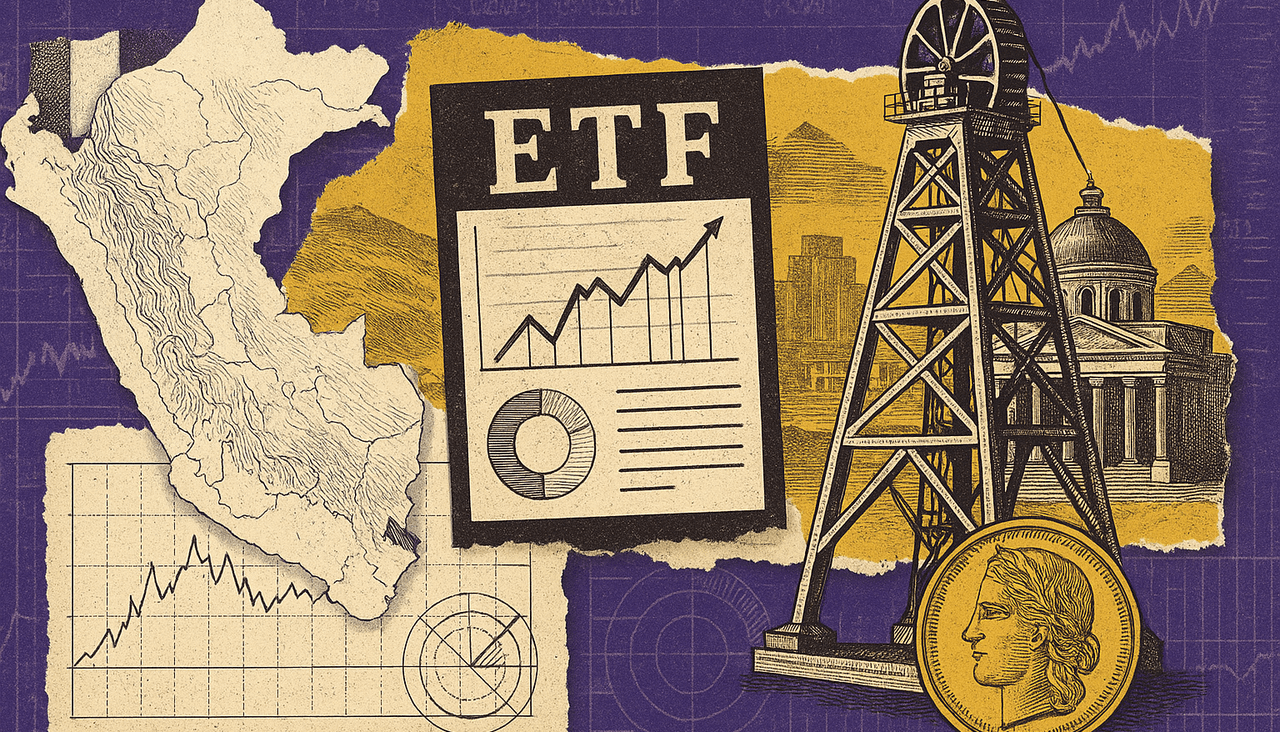
There is exactly one straightforward way for most retail investors to buy "Peru" in a single trade: the iShares MSCI Peru and Global Exposure ETF, ticker EPU. It sounds like the ultimate patriotic portfolio - one fund, your whole home market. But when you open the hood, EPU is not really a bet on Peru's economy at all. It is a concentrated bet on copper, precious metals, and a couple of big banks. That gap - between what a single-country ETF feels like and what it actually holds - is one of the most useful lessons a Peruvian investor can learn, and EPU teaches it better than any textbook.
This is not a recommendation to buy or avoid EPU. It is a walkthrough of how to read a single-country ETF - what its composition tells you about concentration risk, home bias, and why "investing in my country" is rarely the diversified move it appears to be.
EPU is a fund managed by BlackRock's iShares that tracks an index of companies with economic exposure to Peru. As of its March 2026 fact sheet it held around 34 securities and the top ten made up roughly 73% of the whole fund. For comparison, a broad US fund tracking the S&P 500 spreads your money across 500 companies. EPU spreads it across a few dozen, and concentrates most of it in a handful.
The two largest holdings alone tell the story. Credicorp - the financial group behind Banco de Crédito del Perú - was about 24.5% of the fund. Southern Copper was roughly 22%. So nearly half of EPU sits in just two names: one bank and one copper miner. The rest of the top ten is dominated by mining companies - Buenaventura, Hochschild, Pan American Silver, Volcan - with a handful of consumer and industrial names rounding it out.
The sector breakdown is the real headline
Look past the individual names and the sector weights make the concentration unmistakable. Materials - which is essentially mining here - was about 51% of the fund. Financials were roughly 30%. Together, mining and banks account for around four out of every five dollars in EPU. Everything else - consumer, industrials, real estate, utilities, health care - shares what is left.
iShares itself labels the fund "non-diversified," and that is not a warning to skip past - it is the whole point of understanding what you are holding. A single-country emerging-market ETF is a focused instrument, and BlackRock's own materials note it can experience high volatility.
Here is the mental shift that matters. Because EPU is roughly half mining, its returns track the price of metals - copper, gold, silver, zinc - far more closely than they track, say, Peruvian consumer spending or GDP growth. When copper rallies, EPU tends to rally. When metals slump, EPU usually falls with them, almost regardless of what is happening in the rest of the Peruvian economy.
That mirrors the Bolsa de Valores de Lima (BVL), Peru's stock exchange, which has always been heavy on mining. So the EPU composition is not a quirk of one fund - it is a fair reflection of how concentrated the listed Peruvian market genuinely is. If you invest in "the Peruvian market," you are, to a large degree, investing in metals prices and a few banks. That is worth knowing before you decide it is the safe, familiar choice.
A quick way to sanity-check any single-country ETF: pull its fact sheet, read the top-10 holdings and the sector weights, and ask "what is this fund really exposed to?" For EPU the honest answer is copper, precious metals, and Peruvian banks - not "the Peruvian economy" in any broad sense.
Home bias: the trap of investing in what you know
Home bias is the well-documented tendency to over-invest in your own country's assets simply because they feel familiar and safe. A Peruvian investor loading up on EPU, plus local BVL stocks, plus a home in soles, plus a salary paid in soles, ends up with almost everything they own riding on one small, commodity-driven economy and one currency.
The problem is correlation. If copper prices fall, it can hit the mining stocks in EPU, pressure the sol, and slow the broader economy that pays your salary - all at once. Diversification is supposed to protect you by spreading risk across things that do not all move together. Concentrating in your home market does the opposite: it stacks correlated risks on top of each other.
There is also currency risk to keep in mind, and it cuts both ways. EPU is priced in US dollars, so a Peruvian buying it is partly betting on the dollar-sol exchange rate on top of the underlying stocks. If the sol strengthens against the dollar, your dollar-denominated EPU returns shrink when converted back home; if it weakens, they grow. Neither is good or bad on its own - the point is that a single-country ETF quietly bundles several bets together.
How to use a single-country ETF sensibly
None of this makes EPU "bad." A focused fund can be a legitimate tool - to add deliberate exposure to a theme you believe in, or simply to understand your home market with clear eyes. The mistake is treating a concentrated, commodity-heavy single-country fund as if it were a diversified core holding. It is not built to be one.
Read the fact sheet first. Top-10 holdings and sector weights reveal what you are truly buying - EPU is ~80% mining and banks, not a broad slice of Peru.
Treat it as a satellite, not a foundation. A concentrated single-country ETF is a targeted bet, not the diversified base of a portfolio.
Count your existing home exposure. If your job, home and savings are already in soles and tied to Peru, more EPU adds correlated risk rather than reducing it.
Look outward to diversify. Broad global or US-market funds spread money across hundreds of companies, sectors and currencies that do not all move with copper.
The broader lesson travels well beyond Peru. Every single-country ETF - Mexico's EWW, Brazil's EWZ, Chile's ECH - carries its own concentration fingerprint, usually shaped by whatever dominates that country's exchange. Learning to read EPU teaches you to read all of them, and to see your own portfolio for what it actually holds rather than what it is labeled.
Legal Notice: Education, not advice. Past results do not guarantee future returns. Investing always involves risks.
Newsletter
Markets in your inbox, weekly
Latin America-focused analysis, investment themes and the week in finance.