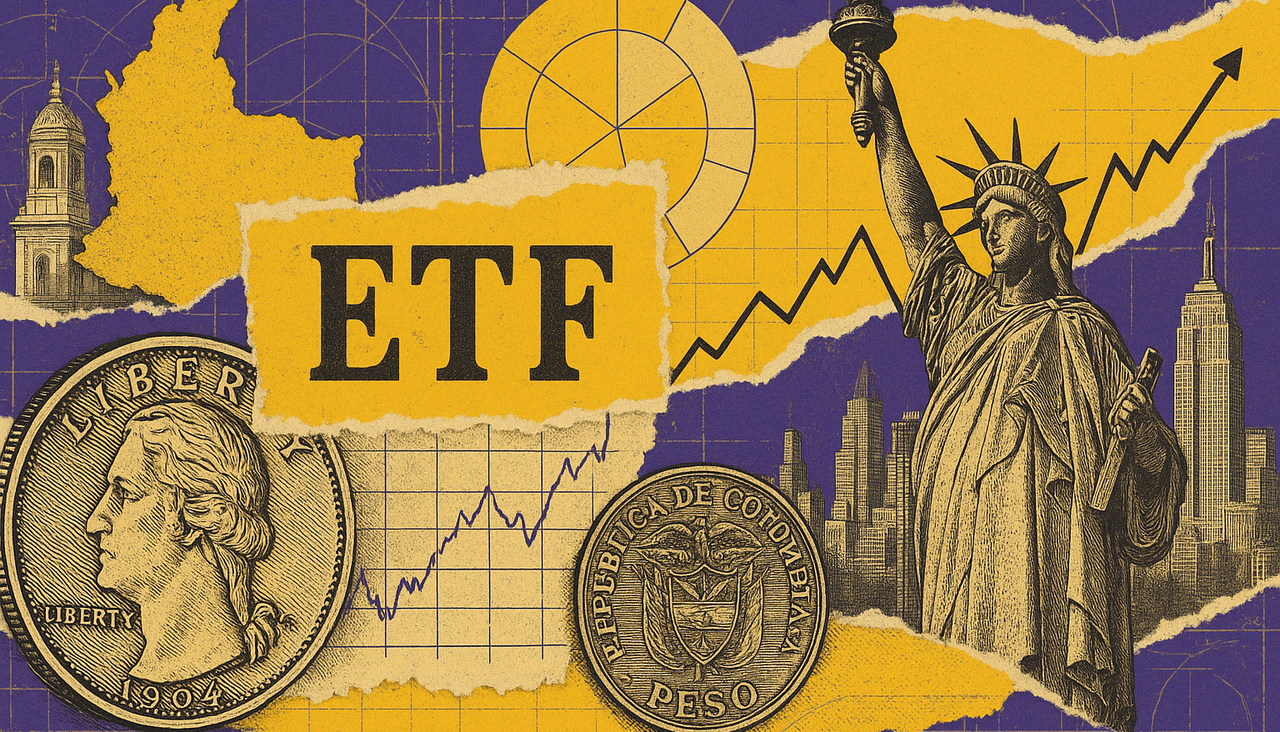
When a Colombian investor buys a US-listed ETF, they are making two bets at once, whether they realize it or not. The first is on the stocks inside the fund. The second is on the US dollar against the Colombian peso. That second bet - the currency one - can quietly turn a good year in New York into a flat year in Bogotá, or magnify a modest gain into a great one. Understanding how the peso moves through your returns is the difference between being surprised by your brokerage statement and actually knowing what you own.
The two engines behind your ETF return
Say you invest in a fund that tracks the S&P 500. Your total return in pesos has two moving parts. The first is the fund's performance in dollars - how much the underlying US stocks rose or fell. The second is the change in the USDCOP exchange rate over the same period. If the fund gains 10% in dollars but the peso strengthens 10% against the dollar, your peso return is close to zero. If the fund gains 10% and the peso weakens 10%, you pocket something closer to 20%. The currency is not a footnote. It is a second engine bolted onto every dollar-denominated position you hold.
This is what economists call currency risk - the chance that a change in exchange rates alters the value of an investment held in a foreign currency. For a Colombian holding US assets, it cuts both ways, and that symmetry is the part most beginners miss. A weak peso helps you; a strong peso hurts you. Neither is guaranteed, and the peso is one of the more volatile currencies in the region.
2026 is a live example, not a hypothetical
You do not need to imagine this. In 2026 the peso staged one of its stronger runs in years. The US dollar started the year worth well over 3,800 COP at its May peak and fell to around 3,050 COP by mid-August - a drop of roughly 15% in the dollar's value against the peso across the year, with an average near 3,600 COP. For a Colombian who held an unhedged US ETF through that stretch, that currency move worked against them: even if their fund rose in dollar terms, a big chunk of the gain was eaten by the appreciating peso when they converted back home.
Flip the calendar back a few years and the story reverses. In periods when the peso weakened sharply - oil-price shocks, global risk-off episodes, local political stress - Colombians holding dollar assets saw their peso returns inflated well beyond what US markets actually delivered. The lesson is not that the peso is good or bad for you. It is that the peso adds a layer of movement you do not control, on top of the market movement you were already signing up for.
Why the peso is not a calm currency
Colombia's currency is unusually sensitive to a few forces. Oil is the big one: crude is Colombia's largest export, so when global oil prices fall, the peso often follows. Global interest rates matter too - when US rates rise, capital tends to flow toward the dollar and away from emerging-market currencies like the peso. And local politics has a strong grip: Colombian assets have historically swung hard around elections and tax-reform debates, and 2026 is a presidential election year, which tends to add volatility of its own.
None of this makes US ETFs a bad idea for a Colombian. If anything, holding globally diversified assets is one way to reduce your dependence on the local economy. But it does mean the currency layer is real, persistent, and worth planning around rather than ignoring.
Hedged versus unhedged: what the choice actually means
Most US-listed ETFs a Colombian buys - the popular S&P 500 and total-market funds - are unhedged from a peso perspective. That is not a flaw in the fund; those products are built for US investors who think in dollars. For you, unhedged means you carry the full USD/COP swing, up and down. It is simpler, usually cheaper, and over long horizons the currency effect tends to wash out somewhat - though "somewhat" is doing a lot of work, and there is no guarantee it evens out over any period you actually care about.
A currency-hedged fund uses financial contracts to strip out most of the exchange-rate movement, so your return tracks the underlying market more closely regardless of what the peso does. The trade-off is cost and complexity: hedging is not free, it adds to the fund's expense ratio (the annual percentage the fund charges to run itself), and peso-hedged share classes are rare and often hard for a retail Colombian to access. In practice, most Colombians will hold unhedged funds and manage the currency risk another way.
How a Colombian investor can actually manage it
You cannot make currency risk disappear, but you can stop it from wrecking your plan. The most powerful tool is time. Currency swings that look brutal over a year tend to matter less over ten, because you are not forced to convert everything at one bad moment. If you will not need the money soon, a strong-peso year is a paper setback, not a realized loss.
Investing steadily instead of in one lump sum helps too. By buying at regular intervals - a practice known as dollar-cost averaging - you convert pesos to dollars at many different exchange rates over time, which smooths out the risk of putting all your money in when the peso happens to be weak. It is the same logic that smooths out stock-price entry points, applied to the currency.
Finally, think about what the money is for. If you are saving in pesos for a peso expense - a home, education, retirement in Colombia - then a portfolio that is 100% in dollars introduces a mismatch: your assets and your future bills move on different currencies. Holding some peso-denominated assets alongside your US ETFs is a form of diversification that matches part of your savings to the currency you will actually spend. There is no single correct split; it depends on your timeline and how much currency swing you can stomach without abandoning the plan.
The takeaway
A US ETF is a peso investment wearing a dollar costume. The stocks inside do one job; the exchange rate does another, and in a year like 2026 the currency did more to shape Colombian returns than the market itself. You do not need to fear that - you need to see it clearly, hold for the long term, invest in regular amounts, and match at least part of your savings to the currency you will spend. Do that, and the peso becomes a factor you have planned for rather than a surprise on your statement.
Legal Notice: Education, not advice. Past results do not guarantee future returns. Investing always involves risks.
Newsletter
Markets in your inbox, weekly
LATAM-focused analysis, investing ideas, and the week in finance.
We use cookies to see how investors use El Fondo and make its tools, data and markets better for you. You can accept or reject; essential cookies always stay on. Privacy Policy